
The purpose of the course on The Importance of the Environment for Health and Development is to explore how environmental factors and surroundings affect people’s health and development. The course is based on the historical development of environmental epidemiology and explores with a broad perspective various environmental factors that can affect our health in the long- or short-term. Different types of environmental contaminants and pollutants that, for example, affect air or water quality are described and linked to exposure routes that are relevant for children and adults, for example in the indoor environment.
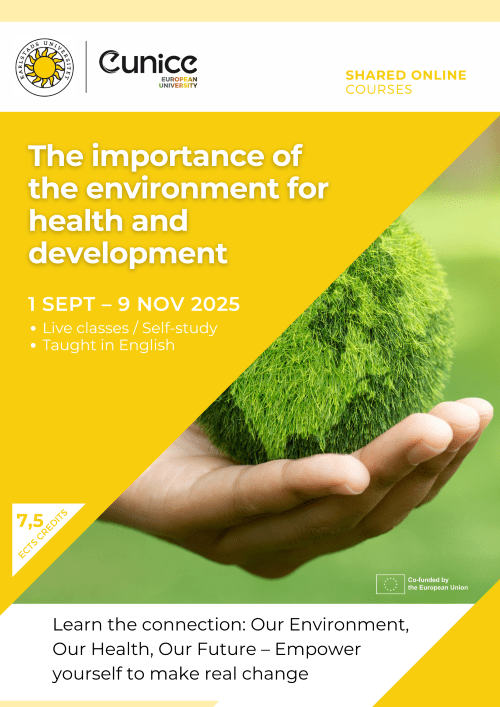
The Importance of the Environment for Health and Development
Upon completion of the course students should be able to:
- define central terms and concepts related to environmental health, including the environment, environmental factors, pollution, routes of exposure and risk assessment,
- account for environmental components, such as nature, built environment and social environment,
- give examples of interactions between environmental factors and human health and development,
- account for specific environmental health problems, in particular problems related to chemical exposure.
- describe connections between environmental factors, exposure and health outcomes,
- use research results and data to support evidence-based strategies for opinion formation,
- apply a critical approach and problem-solving skills to analyse, evaluate and evaluate environmental health problems, critically assess environmental health problems based on their multifaceted nature with a broad perspective.

Timetable:
Part-time course (50%) for ten weeks. The hours for lectures, activities and Reading is 20 hours per week – a total of 200 hrs for the course
- EUNICE master’s degree student: enrolled as a student of a master’s degree at one of the universities of EUNICE European University consortium (check universities here).
- 60 ECTS credits in any field.
- B2 level of English.
Study Level: Master
-
- Submit your application via the button ‘Apply Now’.
- Please keep in mind that the number of participants could be limited for each course. Application does not guarantee enrolment in the course.
- The course participants will be selected based on criteria specified in the study guide.
- Your home university will inform you whether you have been accepted and provide further information about the next steps.
Specific instructions in some universities:
- BTU students: for questions about enrolment and recognition at your university, you can visit this website.
- UPHF students: make sure to ask the approval of your director of studies (responsable pédagogique) before applying. For any question, you can contact the EUNICE office: eunice@uphf.fr.
- UoP students: questions about enrolment and recognition can be answered by your Director of Studies or ECTS Coordinator, or you can contact eunice@go.uop.gr.
Any questions about enrolment or credit recognition? Contact your EUNICE course coordinator.
Learn the connection: our environment-our health-our future, and empower yourself to make real change
Study Level
Master
Master
Applications deadline
11 August 2025
11 August 2025
Dates
1 September - 9 November, 2025
1 September - 9 November, 2025
Part-time course (50%) for ten weeks. The hours for lectures, activities and Reading is 20 hours per week – a total of 200 hrs for the course
Accreditation
7 ECTS
7 ECTS
Mode
Online live
Online live
