Working Visit to UPHF (Université Polytechnique Hauts-de-France) in Valenciennes / Lille
From September 2 to 6, 2025, staff members of the Institute of Applied Mechanics, Faculty of Mechanical Engineering – Dr. Jakub Grabski, Dr. hab. Michał Rychlik, Prof. PP, Dr. hab. Robert Roszak, and Dr. hab. Witold Stankiewicz – visited the Université Polytechnique Hauts-de-France at the invitation of Prof. Sofiane Ghenna.

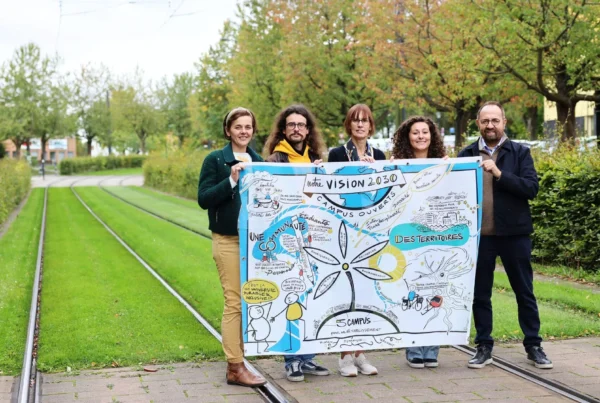
Fig. UPHF building. From left: M. Rychlik, J. Grabski, R. Roszak, W. Stankiewicz, S. Ghenna.
The trip was funded by the NAWA project BPN/BFR/2024/1/00020: “Microsystems Based on Conducting Polymers: Mechanical Design, Simulations, and Fabrication” as well as the Biomedical Engineering Center of Excellence at Poznan University of Technology. It constituted the next stage of a multi-year collaboration between the institutions within the framework of the European University EUNICE. This collaboration has so far included student internships and exchanges, online meetings, and visits of UPHF staff to Poznan, including participation in the Biomedical Engineering Conference organized by Poznan University of Technology.
During the visit, we had the opportunity to become familiar with the organizational structure of the university and its links to the regional industry (particularly the railway sector: Alstom and Bombardier, and the automotive sector: Toyota and PSA), as presented by Daniel Quiroga Quintanilla, mobility coordinator within EUNICE, and Prof. Sébastien Grondel. During our stay, we visited research laboratories in the two main institutes of UPHF.
IEMN
The Institute of Electronics, Microelectronics and Nanotechnology (IEMN, Institut d’Électronique, de Micro-électronique et de Nanotechnologie) is a renowned research institute with laboratories in Valenciennes and Lille, specializing in micro- and nanoscale technologies. It conducts interdisciplinary research in electronics, photonics, acoustics, nanomaterials, and microsystems, combining fundamental sciences with industrial applications.
During our visit to Valenciennes, we had the opportunity to tour the laboratories, including educational labs, and to learn about microsystems developed at IEMN – including cochlear implants, components of an active bronchoscope, and micro-drones. The laboratories were presented by our project partners, Prof. Eric Cattan and Dr. Thanh-Hang Tran, who introduced the current results of their work on conducting polymers. We also conducted discussions with them regarding the ongoing project and potential directions for further research.


Fig. Prof. Eric Cattan presenting MEMS applications based on conducting polymers


Fig. Prof. Sofiane Ghenna presenting the robotics and automation laboratories
One day of our visit was spent in Lille, where we visited one of the largest cleanrooms (ang. cleanroom) in France. There, thanks to the courtesy of Dr. Bacem Zribi, we had the opportunity to observe the microfabrication process of prototypes of the aforementioned devices. In the afternoon, during our free time, we also visited the historic center of Lille.


Fig. Visit in Lille: Cleanroom (on the left Dr. B. Zribi) and the historic city center
LAMIH
The Laboratoire d’Automatique, de Mécanique et d’Informatique Industrielles et Humaines (LAMIH) is a research laboratory at the Université Polytechnique Hauts-de-France in Valenciennes, conducting research in automation, mechanics, industrial computer science, and human-centered studies. The laboratory focuses on interdisciplinary research, including mechatronic systems, intelligent transport systems, biomechanics, ergonomics, and human–machine interactions. LAMIH combines engineering knowledge with social and medical sciences, facilitating the development of innovative solutions that enhance safety, efficiency, and user comfort.During the laboratory tour, we were guided by Dr. Christophe Maréchal, who presented the institute’s research activities.

Fig. Biomechanics laboratory at LAMIH presented by Prof. É. Simoneau


Fig. Materials strength laboratories at LAMIH presented by Prof. F. Lauro
Prof. Laurent Keirsbulck, head of the TEMPO Laboratory (Laboratoire Thermique, Écoulement, Mécanique, Mise en Production), discussed the latest research of his team on wall-bounded turbulence, fluid mechanics metrology, and flow control.

Fig. TEMPO Laboratory. Prof. Keirsbulck presenting the system for measuring aerodynamic resistance and mapping the surroundings during driving
The visit allowed us to become acquainted with the research conducted at UPHF, to strengthen collaboration within the EUNICE network, and to identify potential directions for joint research. The next meeting will take place shortly at the Brandenburg University of Technology (BTU) as part of the Weimar of Excellence initiative.