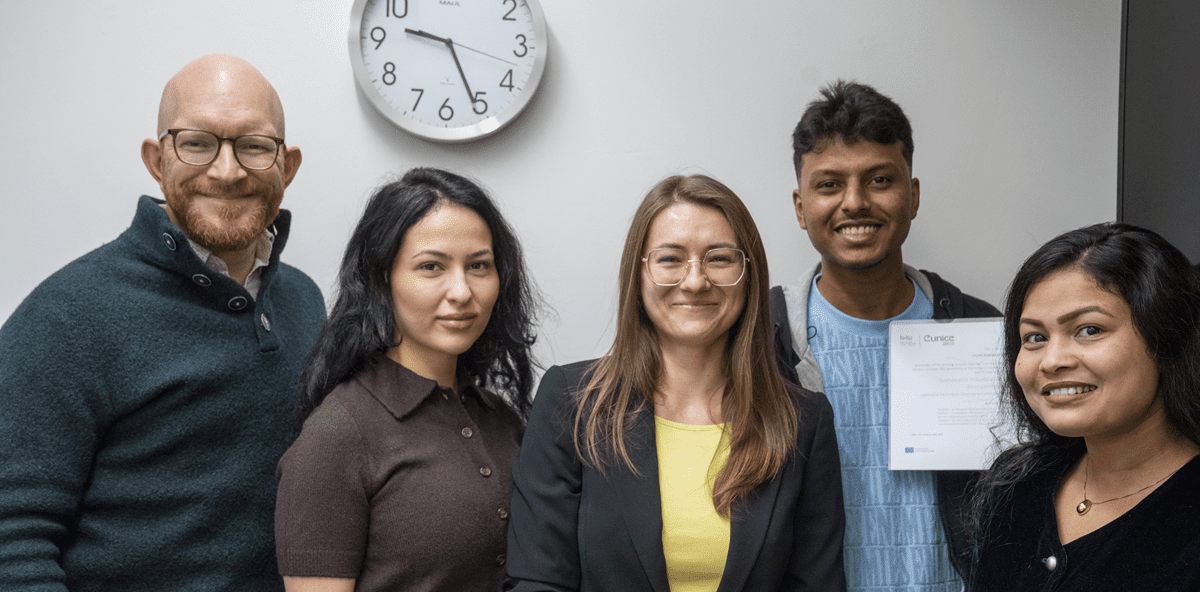
EUNICE Student Research Clubs for the transformation process of the Schwarze Pumpe Industrial Park
Three participants in the Student Research Club visited Cottbus, the ASG Spremberg, the Schwarze Pumpe Industrial Park and the Brandenburg University of Technology Cottbus-Senftenberg (Germany) from 10 to 14 November 2025.
The EUNICE Student Research Clubs (SRC) are a challenge-based competition that offers students from the 10 EUNICE universities the opportunity to gain international experience by working together on a real-life challenge. The theme of the challenge was the recruitment and retention of skilled labour for the at ASG Spremberg and the Schwarze Pumpe Industrial Park (ISP), which is developing an “Innovatorium” to support the transition from coal and lignite mining to sustainable energy production.
The next run of Student Research Clubs is planned for spring 2026 – this time with a twist. Students can set up their own research club on the United Nations Sustainable Development Goals.
”We not only need to recruit foreign professionals, but also prepare locals for multicultural workplaces
Alexander ScharfenbergASG

Students from the EUNICE Student Research Club (SRC) in discussion with ASG representative Alexander Scharfenberg from the Department of Economic Development and Settlement Management

Participants of the EUNICE Student Research Club (SRC) in front of the Competence Centre for Start-ups and Industry at the Schwarze Pumpe Industrial Park (ISP)

Excursion to the open-cast mine in Welzow. We would like to thank the ASG for funding the excursion

Exchange and close collaboration with experts on the SRC challenge “Recruitment and retention of qualified workers for the ISP” in the co-working space of Dock3
Multicultural cooperation
A total of 81 students from a wide range of disciplines and nationalities were selected to participate in the September 202 5call . The students were divided into 16 teams and then met virtually for a month to develop concepts and strategies on how to meet the growing demand for skilled labour through the emergence of the ISP’s Innovatorium.
The winning pitch was presented by Amanda Saliba (Karlstad University), Ripa Dash (University of Vaasa), Sessi Giovanni (Université Polytechnique Hauts-de-France), Chandrakiran Reddy Kasireddy and Aneetta Bijoy (BTU Cottbus-Senftenberg). The team presented an innovative approach to attracting and recruiting talent, their “ecosystem” for retaining and attracting talent and their ideas on the integration process of migrant workers that help to fulfil the requirements of the ISP Innovatorium.
ASG representative Alexander Scharfenberg from the Economic Development and Settlement Management Department at ISP explained that the six presentations were really good: ” The winning club impressed me with their creativity and ability to approach each question with a strategy to overcome the multiple challenges of the ISP transition process.”
The onsite programme included a series of presentations and discussions between the students and ISP experts on topics of skills recruitment and retention, sustainable cities and communities, and the infrastructure needed to attract talented workers to rural areas. The highlight of the programme was a trip to the open-cast mine in Welzow.
The Student Research Clubs not only offered the students the unique opportunity to develop solutions to a real problem in an international and interdisciplinary team. The ASG and the ISP as industrial partners also benefited from the potential of the collaboration with the EUNICE students. “It was an educational experience for both sides, as we realised that we not only need to recruit foreign professionals, but also take into account the local mentality and prepare locals for multicultural workplaces. We will definitely take these valuable insights into account when developing our corporate strategy,” reports Alexander Scharfenberg.
Chandrakiran, a member of the winning team, would like future applicants to know that “The entire Student Research Clubs programme was excellent. It offered us students a great combination of education, industry and international networking. I highly recommend all students to participate.”