
EUNICE Pilot Seed Funding Programme
Deadline: 10 October 2026
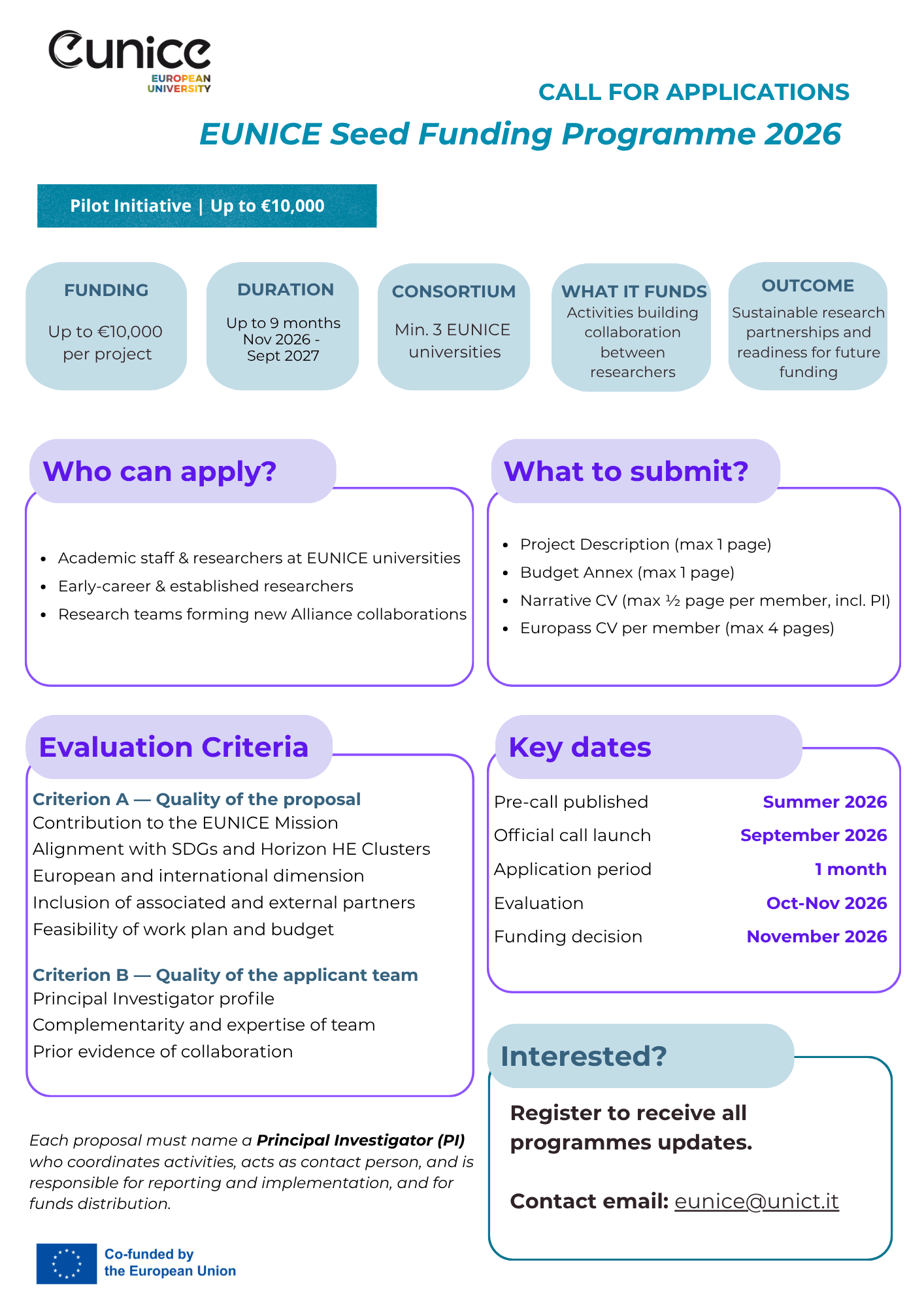
Funding: up to €10,000 per project
The EUNICE European University Alliance launched its first Pilot Seed Funding Programme, with the official Call for Applications having been opened on September 14, 2026.
Rather than funding research itself, the programme supports preparatory activities that help researchers build strong consortia, develop joint research agendas and prepare competitive proposals for future European and international funding opportunities.
What is the programme for?
The Seed Funding Programme aims to:
- Stimulate new research collaborations among EUNICE partner universities.
- Strengthen interdisciplinary and international research networks.
- Support consortium building and strategic partnerships.
- Facilitate knowledge exchange and researcher mobility.
- Develop long-term collaborative research agendas.
- Increase researchers’ capacity to participate in competitive European and international funding programmes.
Funding & Duration
Up to €10,000 per project, provided as a lump-sum contribution.
Funding is intended exclusively for preparatory collaborative activities leading to future joint research proposals. It does not cover research costs, equipment purchases or salaries.
Maximum duration: 9 months
Implementation period: November 2026 – September 2027
Who can apply?
Who can apply?
Applicants must meet the following requirements:
- The Principal Investigator (PI) must be affiliated with a EUNICE partner university participating in the pilot call.
- The consortium must include at least three researchers from three different EUNICE universities.
- One institution will act as coordinating beneficiary and receive the full grant.
- Researchers at all career stages are eligible. Applications led by early-career and consolidating researchers are particularly encouraged.
- Additional EUNICE universities not participating in the funding scheme may join the consortium without receiving funding.
- The participation of Associated Partners, external academic institutions, industry, public authorities and societal stakeholders is strongly encouraged where relevant.
What can be funded
What can be funded?
Funding may support activities that strengthen collaboration and prepare future research initiatives, such as:
- Consortium-building meetings
- Networking workshops and matchmaking events
- Researcher mobility and short scientific visits
- Travel and subsistence for partnership development
- Stakeholder engagement activities
- Training in proposal development, networking and collaboration
- Feasibility studies and strategic planning
- Development of joint research roadmaps
- Activities related to Open Science, impact, gender equality, diversity and inclusion, where relevant
The funding does not cover research costs, equipment purchases or salaries.
How will proposals be evaluated?
How will proposals be evaluated?
Applications will be assessed competitively by an Alliance-wide Review Committee, composed of experts nominated by participating EUNICE universities.
Committee members will declare conflicts of interest and will not evaluate proposals involving their own institution.
Evaluation criteria – 40 points
A. Quality of the proposal – 25 points
Contribution to the EUNICE Mission – 15 points
- Alignment with SDGs and Horizon Europe priorities – 5 points
- European added value and international dimension – 5 points
- Involvement of Associated/External Partners – 5 points
Feasibility of the work plan and budget – 10 points
- Budget coherence – 5 points
- Work plan and timeline (Gantt chart) – 5 points
B. Quality of the consortium – 15 points
- PI profile – 5 points
- Complementarity of expertise – 5 points
- Previous collaboration or demonstrated collaboration potential – 5 points
Institutional balance
To maximise participation across the Alliance, institutional balance may also be considered when recommending projects for funding.
Where proposals of comparable quality are coordinated by researchers from the same university, preference may be given to proposals led by different EUNICE institutions, while maintaining a merit-based evaluation.
What documents are required?
What documents are required?
Applications will include:
1. Project Description – maximum 1 page
- Project title
- Principal Investigator
- Consortium composition
- Objectives
- Planned preparatory activities
- Expected outcomes
- Added value for EUNICE
2. Budget Annex – maximum 1 page
- Budget table
- Budget justification
- Implementation timeline (Gantt chart or equivalent)
3. Narrative CV
- Maximum half a page per consortium member
4. Europass CV
- Maximum four pages per participant
Reporting
Reporting
At the end of the project, beneficiaries will submit a concise final report covering:
- Activities implemented
- Outcomes achieved
- Added value for the EUNICE Alliance
- Future collaborative funding opportunities identified
- Follow-up activities and sustainability plan
Start preparing now
The official Call for Applications is out now.
This call gives prospective applicants the opportunity to:
- Identify potential EUNICE partners
- Develop collaborative research ideas
- Build their consortium
- Prepare the required documentation


